Showing posts with label 2005. Show all posts

Thursday, February 9, 2012

Book Review: Nicolas Dickner, Nikolski


“Archaelogy is the discipline of the future, Every time an old IBM finds its way to the dump, it becomes an artifact. Artifacts are the main products of our civilization. When all the computer experts are unemployed, we’ll still have millions of years of work ahead of us. That is the fundamental paradox of archaeology. Our discipline will reach its peak at the end of the world.”
These are the wise words of one Thomas Saint-Laurent, a secondary yet key character in Nicolas Dickner’s crafty first novel Nikolski. It is an appropriate statement, as its undertones apply to all three of the main protagonists looping through Dickner’s literary excavation site. Dickner himself takes on the role of archaeologist throughout the novel, evaluating with ease and discipline the lives, experiences, and intentions of his multi-faceted characters. These evaluations occur in a similar fashion as to how we the readers may guide guests through a photo album or slide show, pausing on a singular photo, working through the memories from the bits of information contained within its boundaries and then moving on to the next without any further regard.

Nikolski initiates with the narration of an unnamed young man who represents one point on the interlocked triangle of Dickner’s archaelogical zone of personal destiny. Through this young man, the reader learns that Nikolski is a tiny village on Unmak Island in the Aleutians “[i]nhabited by thirty-six people, five thousand sheep and an indeterminate number of dogs,” and the final resting place of one Jonas Doucet.

For the unnamed narrator, Nikolski is the name with which he christens a treasured plastic compass, the only item he has of his father Jonas. This compass is a constant companion for the narrator following the death of his mother, strung around his neck like a grown-up version of a baby pacifier. It is the only link the narrator has to life as he knew it, and to the life he thinks could have been. The constant companionship of the compass with the unnamed narrator also keeps the reader tied to the soon-to-be colliding biographical and geographical worlds of the narrator’s yet unknown family branches, as evidenced in the compass’ refusal to point anywhere but Jonas’ final resting spot.

As the story progresses, it is revealed that Jonas is also the father of Noah, an archaeology student from Saskatchewan. Noah is half-Chipewyan, raised solely by his mother Sarah in the back of an ever-moving caravan nicknamed “Grampa.” Sarah and Noah roam across Canada, barely staying in any of the towns they encounter on their nomadic adventures. Noah decides to move to Montreal to study archaelogy, specifically nomadic peoples, leaving his mother to continue passing through the Canadian landscape solo. A large component of his story is the continuous act of writing letters to Sarah, picking post offices based on ever-slipping knowledge of her travel patterns to which to send his life updates.

The third protaganist is Joyce, recently transplanted from the East Coast where she was raised by her widowed father. Joyce grew up listening to the grand stories of her family’s long lineage of pirates and buccaneers from her grandfather, storied including the seafaring life of her uncle Jonas. One day Joyce learns that her mother is not dead, and has been seemingly peddling the family legacies south of the border. This knowledge propels Joyce to bolt from her small town existence and head for Montreal. Joyce dreams of being a pirate like her legendary ancestor, Heremegilde Doucet, and she makes this a reality by becoming a computer hacker and identity thief.

Once all three individuals converge on the same stomping ground, Nikolski starts to pick up a little steam by showing how their lives intersect, albeit independently, through the second-hand bookstore where the unnamed narrator works. Joyce finds a job at a local fish market, working with immigrant Maelo who happens to be sharing a flat with Noah. Neither Joyce nor Noah ever meet though despite their one degree of separation; they remain ignorant of their biological connections, their shared genetic predisposition to nomadism.

And the idea of nomadism is the arching untidiness that Dickner uses to define his central thesis. Nikolski is pinned together by coincidences and chances that fan together into an absorbing rumination on destiny. All three protagonists are soloists, seeking connection with the world around them but in controlled measures they believe to be of their own making. Yet Dickner writes their world and experiences such to portray that none of the characters escapes the machinations of fate. The events through which their connections appear and dispel are inexplicable, "[a]nd that is exactly the trouble with inexplicable events, you inevitably end up interpreting them in terms of predestination, or magic realism, or government plots."

The concept of predestination seems hokey but transforms under Dickner’s guidance into a charming exercise of narrative randomness. Each character’s story represents different points on the Nikolski compass with the needle swaying endlessly between desire for the open road and longing for a singular place to call home. The untidiness mentioned earlier inspires numerous loose ends that never get resolved by the conclusion of the novel. Readers may be discouraged at the lack of challenge or action devices thrown in the path of these characters.  

Nikolski is not a novel to pursue if wanting a perfunctory ending or conclusionary coda. Its cleverness lies in the ways Dickner plays with such potential inevitabilities through evocative imagery and a cast of eccentric and believable characters. He picks up and picks at the artifacts created through each character’s experiences and renders an elegant and creative view of their world. Nikolski is a high achievement in storytelling, by craftily threading an allusive story that propels the reader to do just the same.

*Winner - Canada Reads 2010
*Winner - 2008 Governor General's Award for English to French Translation
*Winner - 2006 Prix Anne-Hébert

Saturday, May 22, 2010

Table of Contents: A Short History Of Tractors In Ukrainian

A Short History of Tractors in UkrainianAuthor: Marina Lewycka
Publisher/Year: Penguin, 2005
Synopsis: Set in Peterborough, 84-year old Ukranian immigrant Nikolai Mayevskyj announces to his daughters that he's in love and will remarry. The object of his affection is Valentina, a 36-year old Ukranian woman with a visa about to expire and a pair of marvelous breasts. She's determined to use Nikolai to achieve the Western lifestyle she's assured she deserves, and he's willing to let her while he works on his book about the history of tractors. Meanwhile, his daughters, although markedly different in outlook and lifetime rivals, band together to thwart Valentina's ambitions. Valentina's turns their family home inside out, digging up old family secrets in the process. It's a battle of wills with all the participants shaped by their own pasts through recent Eastern European history.

What Others Have To Say
The San Francisco Gate
"Lewycka is a natural writer, a humorist with a light touch who draws the reader in to a family feud that is utterly funny but also stricken with plaintive sadness over the effects of war and inequity on human relationships."

The Guardian
"Reading this novel gave me the impression that I had read a school textbook on Ukrainian history with one eye on an episode of Coronation Street."

Houston Chronicle
"Though well-intentioned, the brief passages of tractor history bring the story to a standstill. Lewycka wants us to mull over the idea that the same ingenious minds that could construct peaceful agricultural machines could convert them into tanks for war."

Tuesday, May 18, 2010

Table of Contents: The History of Love

The History of Love: A NovelAuthor: Nicole Krauss
Publisher/Year: W.W. Norton & Company, 2005
Synopsis: Leo Gursky, an elderly Jewish man who survived World War II in Poland before coming to New York City. He's a terribly lonely man who missed out on the life he wanted to live and the woman he wanted to love, and he does something every day to try to get someone, anyone, to notice him. While in Poland, he wrote books where he named the female character after the woman he loved. Alma Singer is a 15-year old girl named after a character in her parents' favorite novel, The History of Love. Her father has died and her mother has been hired to translate The History of Love from its original Spanish. Alma and her brother, Bird, struggle to understand their world after their father's death, and Alma sets out to understand the story of this novel and the woman for whom she was named.

What Others Have To Say
Houston Chronicle
"The plot involves a book-within-a-book, with characters from one story invading the other one in Paul Auster-like fashion, and depends on some largely undigested globs of magical realism to move things along."

The Washington Post
"...involves several narrators and moves back and forth through the 20th century and around the world. But that's just for starters: It contains a lost, stolen, destroyed, found, translated and retranslated book called "The History of Love," characters named for other characters, cases of plagiarism and mistaken identity, and several crucial coincidences and chance meetings that are all maddeningly scrambled in an elliptical novel that shouldn't work but does."

The New York Times
"there's less of the earnest A-student striving that often mars Krauss's efforts to live up to her idols, especially when she's trying to be funny."

The Guardian
"Krauss is undoubtedly an entertaining, humane and intelligent writer, but this novel is just too neat and too sweet for her talent to fly freely."

Monday, April 26, 2010

Line By Line: Curtis Sittenfeld, Prep

Prep: A Novel"I always worried someone would notice me, and then when no one did, I felt lonely."
"'The big occurrences in life, the serious ones, have for me always been nearly impossible to recognize because they never feel big or serious. In the moment, you have to pee, your arm itches, or what people are saying strikes you as melodramatic or sentimental, and it's hard not to smirk. You have a sense of what this type of situation should be like - for one thing, all-consuming - and this isn't it. But then you look back, and it was that; it did happen."

Our relationship, for as long as things were good, and in that moment when they could have been good again, was about the irrelevance of words. You feel what you feel, you act as you act, who in the history of the world has ever been convinced by a well-reasoned argument?"

"There are people we treat wrong and later we're prepared to treat other people right. Perhaps this sounds mercenary, but I feel grateful for these trial relationships, and I would like to think it all evens out - surely, unknowingly, I have served as practice for other people."

I always thought I wanted to know a secret, or I wanted an event to unfold – I wanted my life to start – but in those rare moments when it seemed like something might actually change, panic shot through me."

Tuesday, April 6, 2010

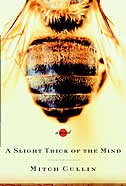
Table of Contents: A Slight Trick of the Mind

Author: Mitch Cullin
Publisher/Year: Doubleday, 2005
Synopsis: It is 1947, and the long-retired Holmes, now 93, lives in a remote Sussex farmhouse, where his memories and intellect begin to go adrift. He lives with a housekeeper and her young son, Roger, whose patient, respectful demeanor stirs paternal affection in Holmes. Holmes has settled into the routine of tending his apiary, writing in journals, and grappling with the diminishing powers of his razor-sharp mind, when Roger comes upon a case hitherto unknown. It is that of a Mrs. Keller, the long-ago object of Holmes's deep-and never acknowledged-infatuation.

As Mitch Cullin weaves together Holmes's hidden past, his poignant struggle to retain mental acuity, and his unlikely relationship with Roger, Holmes is transformed from the machine-like, mythic figure into an ordinary man, confronting and acquiescing to emotions he has resisted his entire life. This subtle and wise work is more than just a reimagining of a classic character. It is a profound meditation on faultiness of memory and how, as we grow older, the way we see the world is inevitably altered.


What Others Have To Say
The New York Times
"This is a novel about the fraying of reason under the stress of unanswerable emotional demands."

Salon
"...proceeds in a circling, unchronological manner that would have driven its subject mad with impatience, but so be it."

The Washington Post
"This is a lovely, tenderhearted book, full of reserve, good manners, elegance of feeling."

San Francisco Gate
"But taken as a whole, the novel lacks the tautness of a Conan Doyle mystery, and, deprived of a mystery around which to work, Sherlock Holmes is rendered even less real."

Monday, March 29, 2010

Line By Line: Jennifer Weiner, Goodnight Nobody

"I blinked in the gloom as the tangle of limbs and hair turned into two extremely attractive people having energetic sex in a position I wouldn't have previously believed physically possible."

"Your bathroom's like a clown car. Do you have a midget in there?"

"Delphine had two of her fingers jammed in a place where ladies of refined breeding don't typically stick their digits--at least not when photographers are nearby."

"Then I got stroll-jacked."

"You should call it E. It makes you sound hipper."

Saturday, March 27, 2010

Table of Contents: Faith For Beginners

Author: Aaron Hamburger
Publisher/Year: Random House, 2005
Synopsis: In the summer of 2000, Israel teeters between total war and total peace. Similarly on edge, Helen Michaelson, a respectable suburban housewife from Michigan, has brought her ailing husband and rebellious college-age son, Jeremy, to Jerusalem. She hopes the journey will inspire Jeremy to reconnect with his faith and find meaning in his life . . . or at least get rid of his nose ring.

It’s not that Helen is concerned about Jeremy’s sexual orientation (after all, her other son is gay as well). It’s merely the matter of the overdose (“Just like Liza!” Jeremy had told her), the green hair, and what looks like a safety pin stuck through his face. After therapy, unconditional love, and tough love . . . why not try Israel?

Yet in seductive and dangerous surroundings, with the rumbling of violence and change in the air, in a part of the world where “there are no modern times,” mother and son become new, old, and surprising versions of themselves.


What Others Have To Say
The New York Times
"The novel is consistently amusing, particularly when Hamburger offers barbed observations about the banalities of tourist culture."

Booklist
"This novel is highly recommended for anyone who is drawn to stories of family affected by the global political context of everyday life."

Frontiers Magazine
The author's shrewd and satirical look at Judaism, and American and Israeli style, is in the great tradition of Philip Roth, and makes for an absorbing read."

Saturday, March 20, 2010

Table of Contents: The Historian

Author: Elizabeth Kostova
Publisher/Year: Little Brown, 2005
Synopsis: The Historian of Elizabeth Kostova's novel is Paul, who years before the novel begins was drawn into a historical search for Vlad the Impaler, the Romanian tyrant who inspired Dracula, when he found a colleague's book with just an illustration of a dragon in its center. Paul's daughter narrates the story, telling of her search for the historical truth behing Vlad the Impaler, to understand her father's past and her mother's mysterious fate. As she explores through ancient texts and clues scattered across Europe, she discovers to her horror that Vlad is the possessor of a ancient evil power and is still alive, or at least at some level of existence. It's an evil that she must confront and understand if her father is to be saved.


What Others Have To Say:
Salon
"Kostova has a genius for evoking places without making you wade through paragraphs of description."

The New York Times
"Although ''The Historian'' is wearyingly long, it would be a difficult book to compress."

January Magazine
"Time and again, her story gets tangled up in the travel text, and one gets the feeling she's filling pages rather than storytelling."

London Times
"character is plot"

The Guardian
"Kostova is a whiz at storytelling and narrative pace, and she can write atmospheric descriptions of place, but she has no great sense of the location of language within time, and not much talent for impersonation."

Tuesday, January 26, 2010

Table of Contents: Towelhead

Author: Alicia Erian
Publisher/Year: Simon & Schuster, 2005
Synopsis: The year is 1991. When Jasira's mother finds out what has been going on between her boyfriend and her thirteen-year-old daughter, she has to make a choice -- and chooses to send Jasira off to Houston Texas, to live with her father. A remote disciplinarian prone to explosive rages, Jasira's father is unable to show his daughter the love she craves -- and far less able to handle her feelings about her changing body.

Bewildered by extremes of parental scrutiny and neglect, Jasira begins to look elsewhere for affection. Saddam Hussein has invaded Kuwait, and high school has become a lonely place for a "towelhead." When her father meets, and forbids her to see, her boyfriend, it becomes lonelier still. But there is always Mr. Vuoso -- a neighboring army reservist whose son Jasira babysits. Mr. Vuoso, as Jasira discovers, has an extensive collection of Playboy magazines. And he doesn't seem to think there's anything wrong with Jasira's body at all.


What Others Have To Say:

The New York Times
"[Erian's] gift for conjuring characters is so strong; she has a sophisticated take on people, and charts with real precision how and why the human comedy becomes seriously unfunny."

The New York Times (2)
"The true coming of age here involves not the loss of Jasira's virginity (which becomes a hopelessly confused point of contention among the story's men) but the birth of her assertiveness and self-esteem."

Bookpage.com
"It is a tale simply told, in straightforward language, about age-old truths that are anything but simple."

Extras:
Read an interview with the author.
View the trailer for the film adaptation.
Read Chapter 1 online.

Tuesday, January 19, 2010

Table of Contents: The Ivy Chronicles

Author: Karen Quinn
Publisher/Year: Viking, 2005
Synopsis: When turbocharged Park Avenue mom Ivy Ames finds she's been downsized from her high-powered corporate job and her marriage, she swiftly realizes that she's going to need a whole new way to support herself and her two private-school daughters. At first she does the obvious thing: she panics. Then she decides to put her years of marketing savvy to work and dreams up a brilliant new business - helping upscale New Yorkers get their little darlings into the most exclusive kindergartens in the city.


What Others Have To Say:

Allison Pearson, Author
"A very funny and frequently eye-popping tale of unnatural selection in the jungle of New York City’s private kindergartens."

Extras:
Sarah Jessica Parker to star in movie adaptation.
Read an excerpt from The Ivy Chronicles!